

A Practical Guide to Lip Fillers: What to Know

What Are Lip Fillers and How Do They Work?

Lip augmentation is one of the most popular minimally invasive aesthetic procedures in the world. In 2018 alone, healthcare providers performed over 2.1 million lip filler procedures. The treatment works by strategically depositing soft, gel-like substances beneath the delicate mucosal tissues of the lips to enhance physical volume, restore structural symmetry, and hydrate the perioral area.
Modern injectables are primarily composed of synthetic hyaluronic acid (HA). Hyaluronic acid is a naturally occurring glycosaminoglycan found throughout the human body's connective tissues, skin, and joints. Because of its unique hydrophilic chemical structure, a single molecule of HA can bind up to 1,000 times its weight in water. When injected into the lip architecture, it acts as an internal sponge, delivering immediate shape while drawing in deep hydration.
The vast majority of modern hyaluronic acid fillers are FDA-approved for adult patients aged 21 and older. During a typical treatment session, an injector uses an average volume of approximately 1 mL of filler. To put that in perspective, 1 mL is roughly one-fifth of a standard metric teaspoon. This conservative volume is placed precisely into specific tissue planes—generally at an anatomical depth not exceeding 2.5 mm—to ensure natural mobility without creating stiffness or distorting your natural smile. For a broader look at candidate qualifications and procedural standards, explore this scientific overview of lip filler safety and benefits.
Hyaluronic Acid Formulations and Tissue Integration
Hyaluronic acid fillers are manufactured using biofermentation processes (often utilizing Streptococcus bacteria cultures) and stabilized using cross-linking agents such as 1,4-butanediol diglycidyl ether (BDDE). The degree of cross-linking, particle size, elastic modulus ($G'$), and gel cohesivity determine how a specific product performs once placed in dynamic oral tissues.
Different treatment goals call for distinct product rheologies:
High Elasticity and Volume: Products engineered for structural support provide reliable projection, border crispness, and shape correction. Many patients achieve seamless, pillowy results with smooth Juvederm gel formulations, which integrate smoothly into mucosal tissues.
Dynamic Flexibility: For patients who prioritize natural movement during speaking, laughing, and eating, flexible Restylane injectables offer specialized particle sizing that stretches alongside dynamic muscle contractions.
Balanced Uniformity: Premium formulations like Versa hyaluronic acid utilize uniform, spherical particle technology to minimize immediate post-injection swelling and deliver smooth, balanced integration.
Fine Rhytid Correction: Formulations with smaller particle profiles are tailored specifically for delicate perioral lines and subtle vermilion borders. For regulatory and technical administration details on these targeted gels, consult the Instructions for use Restylane Silk US.
Lip Fillers vs. Botox Lip Flips
Patients often wonder whether they need dermal fillers or a neurotoxin "lip flip." While both procedures enhance the appearance of the mouth, their biological mechanisms, longevity, and visual outcomes differ significantly.
Feature | Dermal Lip Fillers (Hyaluronic Acid) | Botox / Dysport Lip Flip (Neurotoxin) |
Primary Mechanism | Physically adds structural volume and gel matrix under tissue | Relaxes superficial orbicularis oris muscle fibers |
Visual Effect | Adds measurable volume, enhances border, corrects asymmetry | Rolls the upper lip outward (eversion) to show more vermilion |
Longevity | Typically lasts 12 to 18 months | Typically lasts 8 to 12 weeks |
Onset of Results | Immediate structural change (settles over 2 to 4 weeks) | Gradual onset over 3 to 14 days |
Best For | Thin lips, volume loss, defining the Cupid's bow, deep hydration | "Gummy" smiles, subtle upper lip curl without added fullness |
While dermal fillers physically build shape, neuromodulator treatments like Botox and Dysport simply alter dynamic muscle tone. During a lip flip, tiny micro-doses of neurotoxin relax the hyperactive fibers of the orbicularis oris muscle along the upper vermilion border. This relaxation prevents the upper lip from curling inward when you smile, creating the optical illusion of a fuller lip without adding physical volume. In many clinical plans, combining both modalities provides optimal perioral rejuvenation.
Aesthetic Goals, Proportions, and Perioral Anatomy
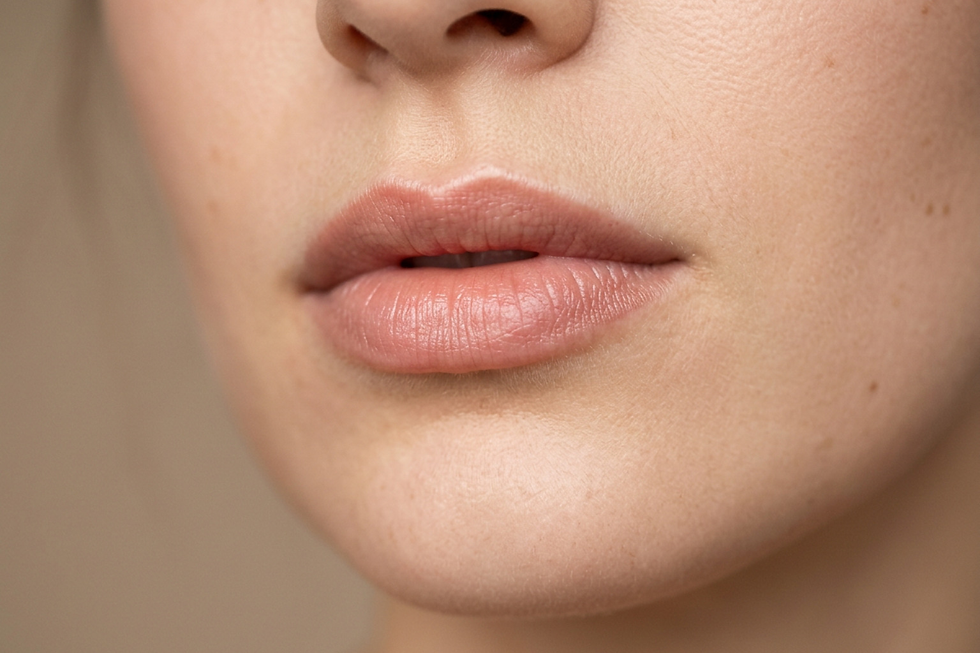
Successful lip augmentation relies on an intimate understanding of facial anatomy and aesthetic balance rather than simply placing filler into the body of the lip. The perioral region consists of intricate anatomical landmarks, including the vermilion border (the distinct line separating lip mucosa from cutaneous skin), the white roll (the subtle, raised pale line directly above the vermilion border), the Cupid's bow, the vertical philtral columns, the oral commissures (corners of the mouth), and the distinct wet-dry mucosal junction.
Cadaveric and histological studies demonstrate that the lips are divided into 24 distinct anatomical compartments and fat pads. Respecting these boundaries allows an injector to restore balance, correct congenital asymmetry, and support dynamic facial movement during speech and smiling.
Upper-to-Lower Lip Ratios and Cupid's Bow Definition
A classical benchmark in facial aesthetics is the golden ratio. In traditional Caucasian facial aesthetics, the ideal vertical height ratio between the upper lip and lower lip is approximately 1:1.6. In this aesthetic framework:
The lower lip should be noticeably fuller than the upper lip.
The upper lip should feature a well-defined Cupid's bow with gentle peaks.
The central lower lip should exhibit two distinct lateral fullness lobes with a subtle central depression.
To define the Cupid's bow without creating an artificial, shelf-like appearance (often described as "duck lips"), clinicians place microboluses of filler precisely along the vermilion border. Treating the philtral columns requires stopping the retrograde injection approximately 1 mm before reaching the subnasal base (the Glogau-Klein point). This preserves the natural subnasal crease, ensuring the philtrum appears defined rather than rigid or flattened.
Gender, Age, and Ethnic Considerations
Aesthetic goals must always be personalized based on age, gender identity, and ethnic background:
Gender Dynamics: From a profile view, female lips naturally project further forward, exhibiting a distinct pout and well-defined border curves. Male lips, by contrast, possess wider horizontal dimensions, flatter lateral profiles, and less vertical vermilion show. Over-volumizing a male lip or over-accentuating the Cupid's bow can unintentionally feminize the perioral area.
Age-Related Changes: As we age, lip volume naturally deflates due to the loss of dermal collagen, bone resorption in the maxilla and mandible, and subcutaneous fat atrophy. The cutaneous upper lip lengthens, the philtral columns flatten, the oral commissures turn downward (creating a perpetual frown), and vertical "barcode" lines (perioral rhytides) form. Rejuvenation in mature patients focuses on restoring perioral structural support and softening wrinkles rather than aggressive volumization.
Ethnic Proportions: The classic 1:1.6 ratio is not universal. Many individuals of African, Hispanic, and Mediterranean descent naturally possess a balanced 1:1 upper-to-lower lip ratio with fuller overall vermilion show. In modern aesthetic medicine, lip augmentation preserves individual heritage and harmonizes with the patient's unique facial proportions.
Clinical Injection Techniques and Safety Standards

Precision and patient comfort are the cornerstones of modern clinical injecting. Because the lips are densely innervated by branches of the trigeminal nerve, pain management is a vital first step. Clinicians typically apply a compounded topical anesthetic—such as a BLT cream (benzocaine, lidocaine, and tetracaine)—for 15 to 30 minutes prior to injection. Alternatively, an infraorbital or mental nerve block can provide complete regional anesthesia without distorting the tissue architecture. Furthermore, most modern hyaluronic acid gels are formulated with 0.3% integrated lidocaine to maintain comfort throughout the procedure.
Needle vs. Cannula and Multi-Vector Mapping
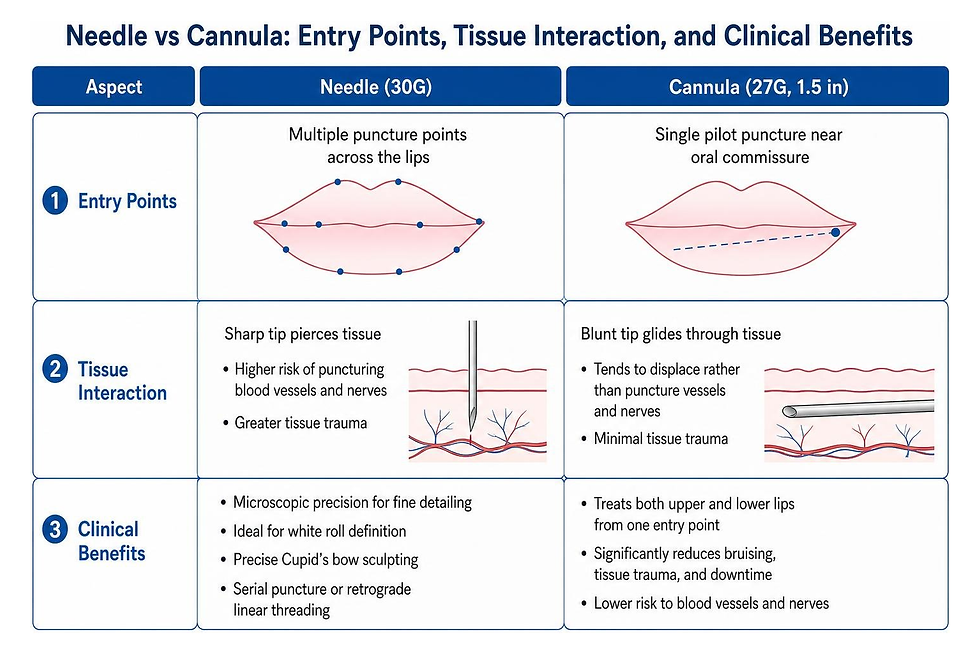
Injectors utilize two primary delivery methods: sharp needles (typically 30-gauge) and blunt-tip microcannulas (typically 27-gauge, 1.5 inches in length). Each offers unique clinical advantages:
Sharp Needle Injections: Allow for microscopic precision when defining the white roll, sculpting the peaks of the Cupid's bow, and performing serial puncture or retrograde linear threading in localized zones. However, sharp needles carry a higher rate of localized bruising and minor tissue trauma.
Blunt-Tip Cannula Injections: A microcannula enters through a single, tiny pilot needle puncture near the oral commissure. The injector can treat both the upper and lower lips from this single entry point. Because the cannula has a rounded tip, it tends to slide past blood vessels and nerves rather than puncturing them, significantly reducing bruising, tissue trauma, and patient downtime.
Advanced injectors frequently employ vector-based approaches to achieve natural eversion (rolling the lip outward) without pushing the tissue forward. For example, a multi-center clinical study on the Multi Vector Lip technique involving 253 patients demonstrated a mean patient satisfaction score of 3.92 out of 4 (excellent). In this study, adverse events were exceptionally low—edema occurred in 15.8% of cases and bruising in 11.1%, with 0% vascular occlusion—by systematically placing micro-vectors in the superficial subcutaneous plane bounded by anatomical landmarks like the lateral incisor teeth.
Vascular Safety and Preventing Occlusion
The most critical safety consideration in lip augmentation is avoiding accidental intravascular injection. The arterial supply to the lips is governed by the superior and inferior labial arteries, which arise from the facial artery.
Cadaveric studies indicate that the superior labial artery runs at an average depth of 5.3 mm, while the inferior labial artery runs at an average depth of 4.2 mm, typically located within the wet mucosa or intramuscular layer. Therefore, keeping injections strictly within the superficial subcutaneous plane (depths $\le 2.5\text{ mm}$) significantly minimizes vascular injury.
Safety protocols also require:
Aspiration: Performing a minimum 3-second mechanical aspiration before depressing the syringe plunger to check for blood flashback.
Low Extrusion Pressure: Injecting tiny increments (microboluses of 0.02 to 0.025 mL per pass) slowly and gently.
Volume Thresholds: Avoiding excessive volumes (exceeding 2.0 to 3.0 mL across both lips in a single session), which increases tissue pressure and post-treatment inflammation.
Immediate Reversal Preparedness: Keeping emergency kits stocked with high-concentration hyaluronidase (an enzyme that rapidly hydrolyzes and dissolves hyaluronic acid), warm compresses, and topical vasodilators like nitroglycerin paste.
Recovery, Longevity, and Essential Aftercare
A lip filler procedure typically takes 30 to 45 minutes, but the biological healing and settling process unfolds over several weeks.
Immediately following the injections, localized inflammatory signaling triggers temporary swelling (edema), redness (erythema), and occasional bruising (ecchymosis). In clinical trials, over 85% of these symptoms were mild and resolved within 2 to 7 days. While initial swelling peaks within 24 to 48 hours, it takes two to four weeks for swelling to fully resolve and the filler to integrate naturally into the lip tissue.

What to Expect During Healing and Settling
During the initial 14 days post-treatment, it is completely normal to experience:
Asymmetry: One side of the lip may swell more rapidly than the other due to uneven localized vascular response. True symmetry cannot be accurately assessed until the 2-week mark.
Palpable Bumps or Firmness: The filler material remains malleable during the first week. Tiny bumps felt with the tongue are usually localized areas of resolving edema or settling gel, not permanent nodules.
Mild Tenderness: Discomfort when chewing or speaking typically dissipates within 24 to 48 hours.
To manage post-procedure swelling, apply a cloth-wrapped cold compress intermittently for 5 to 10 minutes at a time. Never place bare ice directly onto fragile mucosal tissue. For discomfort, use acetaminophen (Tylenol). Avoid non-steroidal anti-inflammatory drugs (NSAIDs) such as ibuprofen, naproxen, or aspirin for at least 6 hours post-treatment, as they thin the blood, worsen bruising, and can mask early signs of localized vascular issues.
Aftercare Protocols for Lip Fillers
Following strict aftercare protocols protects your results, minimizes inflammation, and prevents bacterial contamination:
Postpone Makeup and Lip Products: Do not apply lipstick, lip gloss, or lip liners for at least 24 hours. The injection sites are microscopic open wounds; commercial cosmetics harbor bacteria that can cause infections.
Avoid High-Heat and Strenuous Exercise: Refrain from heavy aerobic workouts, saunas, steam rooms, and hot tubs for 24 to 48 hours. Elevated blood pressure and vasodilation exacerbate swelling and bruising.
Postpone Dental Appointments: Avoid routine dental cleanings or invasive dental procedures for 2 weeks before and 2 weeks after filler injections. Dental work can introduce oral bacteria into the bloodstream, increasing the risk of delayed-onset biofilm infections around the filler.
Be Gentle with Pressure: While gentle kissing, eating, and drinking water do not displace filler, avoid aggressive manual manipulation or deep perioral massage unless specifically instructed by your injector.
Stay Hydrated: Drink plenty of water throughout the first week. Hyaluronic acid binds with water molecules, and proper hydration optimizes tissue integration and fullness.
Sun and Temperature Protection: Avoid UV tanning beds and extreme freezing temperatures until all localized swelling and redness have cleared.
For additional clinical guidance on what to avoid during your healing window, review the Cleveland Clinic guide on lip filler aftercare.
Frequently Asked Questions About Lip Augmentation
How long do injectable fillers last before breaking down?
Hyaluronic acid lip fillers typically last 12 to 18 months. However, individual longevity varies based on your metabolic rate, age, physical activity level, and the specific cross-linking technology of the filler used. Younger patients and athletes with higher metabolic rates break down hyaluronic acid faster than more sedentary individuals. Because filler degrades gradually over time, many patients schedule maintenance touch-ups every 9 to 12 months. To make continuous aesthetic care accessible and seamless, we provide flexible payment plans for aesthetic procedures.
Can hyaluronic acid gel in the lips be dissolved?
Yes. One of the greatest safety advantages of hyaluronic acid fillers is complete reversibility. If you experience overcorrection, asymmetry, superficial filler placement (which can cause a bluish discoloration known as the Tyndall effect), or if you simply dislike the outcome, an enzyme called hyaluronidase can be injected. Hyaluronidase rapidly breaks down the cross-linked sugar chains within 24 to 48 hours, returning your lips to their natural baseline.
What symptoms indicate a vascular complication requiring urgent care?
While serious complications are rare in experienced hands, an accidental intravascular injection (vascular occlusion) is a medical emergency that requires prompt intervention. You should contact your medical provider immediately if you experience:
Severe, Disproportionate Pain: Throbbing pain that worsens rather than improves over the first few hours.
Skin Blanching: A pale, chalky, or white discoloration of the lip or surrounding skin.
Livedo Reticularis: A dusky, purple, mottled, or net-like discoloration spreading across the lip, chin, or nasolabial area.
Delayed Capillary Refill: When pressing on the lip, normal pink color takes longer than 2 to 3 seconds to return.
Conclusion
At Loveland Medical Spa, we believe that aesthetic enhancement should celebrate and refine your natural facial architecture. Under the leadership of our board-certified clinical team, we combine intensive anatomical expertise, advanced medical-grade technologies, and vector-based injection strategies to deliver soft, beautifully balanced lip rejuvenation.
Whether you wish to restore youthful volume lost over time, refine your Cupid's bow, or correct natural asymmetry, we invite you to schedule a personalized lip consultation at our Aventura clinic today. Together, we will design an individualized treatment plan that prioritizes your safety, comfort, and aesthetic goals.


Comments