

Everything You Need to Know About Hyaluronic Filler Types

Hyaluronic Fillers: What They Do and How Types Differ

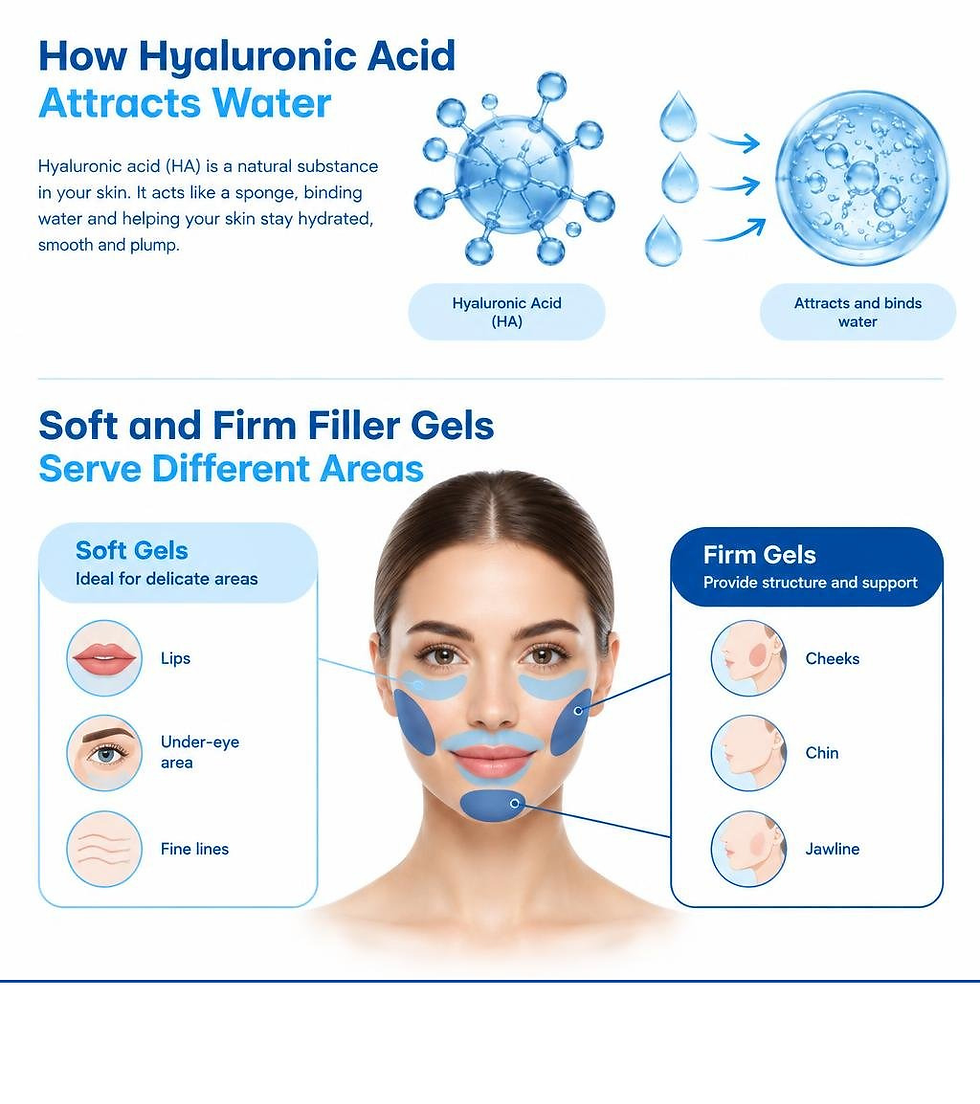
Hyaluronic fillers are injectable gels that add volume, soften lines, and shape facial features. They use hyaluronic acid, a substance found naturally in the skin that attracts water. Softer gels may suit lips or fine lines, while firmer gels can support cheeks or the chin. Results are temporary, often lasting 6 to 18 months, and a qualified clinician can dissolve HA filler with an enzyme called hyaluronidase.
The best type depends on your face, your goals, and where the filler will be placed. This guide explains those choices, along with safety, aftercare, and what to expect from treatment.
I'm Aalaa Ahmad, MSN, APRN, FNP-BC, a board-certified nurse practitioner at Loveland Medical Spa. I have more than 14 years of clinical experience and specialize in non-surgical cosmetic injections, including hyaluronic fillers.
Understanding Hyaluronic Fillers and How They Work
Hyaluronic acid (HA) is a naturally occurring glycosaminoglycan found throughout human connective tissue, eyes, joints, and skin. In our skin, HA acts like an internal sponge, capable of binding up to 1,000 times its molecular weight in water (Wongprasert et al., 2022). This moisture retention keeps young skin radiant, supple, and naturally plump.
As we age, our bodies produce less natural hyaluronic acid, collagen, and elastin. Simultaneously, deep facial fat pads shift downward or shrink, and underlying bone tissue gradually resorbs. These structural shifts result in hollowed cheeks, deeper nasolabial folds, thinning lips, and sagging contours.
Modern cosmetic dermal fillers restore this depleted architecture. Unmodified, natural hyaluronic acid breaks down within 24 to 48 hours in the human body due to endogenous hyaluronidase enzymes. To transform liquid HA into a long-lasting injectable gel, manufacturers use crosslinking technology—most commonly employing 1,4-butanediol diglycidyl ether (BDDE). Crosslinking binds individual HA chains into a resilient three-dimensional matrix that resists rapid metabolic breakdown while remaining biocompatible and well-tolerated.
Rheological Properties of Hyaluronic Fillers
Not all hyaluronic gels behave the same way under the skin. Their physical performance depends on rheology—the science of how soft matter flows, stretches, and resists mechanical pressure (Wongprasert et al., 2022).
Elastic Modulus (G'): Represents gel stiffness and structural lift capacity. Fillers with a high G' (such as structural gels reaching 600 to 670 Pa) resist deformation from facial muscle movement, making them ideal for deep periosteal placement along the chin and jawline (Bertossi et al., 2025).
Viscous Modulus (G"): Reflects the gel's ability to dissipate energy and flow smoothly when sheared.
Cohesivity: Measures how strongly the gel particles hold together. Highly cohesive gels maintain their shape without spreading or migrating away from the targeted injection plane (Wongprasert et al., 2022).
Extrusion Force: Determines how smoothly and predictably the gel passes through fine-gauge needles or micro-cannulas, protecting delicate facial tissues during placement.
Understanding these characteristics allows us to select the exact right gel density for every facial plane, matching structural support to aesthetic treatment with hyaluronic acid fillers for lasting, natural results (Bertossi et al., 2025).
Leading Hyaluronic Acid Filler Types and Formulations

Manufacturers use specialized crosslinking methods and particle-sizing strategies to design distinct product families. Matching the right formulation to your unique tissue thickness ensures smooth integration and natural movement.
Juvederm Product Family
The Juvederm collection utilizes advanced crosslinking platforms, including classic Hylacross technology and newer Vycross technology. Vycross blends high- and low-molecular-weight hyaluronic acid to create smooth, cohesive gels with low swelling tendencies:
Juvederm Voluma XC: Engineered with high G' and high cohesivity for structural midface projection, cheek enhancement, and deep chin augmentation.
Juvederm Volux XC: A high-density structural gel formulated specifically for robust mandibular contouring and crisp jawline definition.
Juvederm Vollure XC: A balanced, flexible gel created for moderate-to-severe nasolabial folds and dynamic perioral lines.
Juvederm Volbella XC: An ultra-soft, low-viscosity filler tailored for delicate under-eye hollows, superficial lipstick lines, and subtle lip hydration.
Juvederm Ultra XC & Ultra Plus XC: Classic Hylacross formulations offering plush volumization for lips and deeper facial creases.
Restylane and Versa Formulations
The Restylane family features two distinct manufacturing technologies designed for targeted anatomical layers:
NASHA Technology (Non-Animal Stabilized Hyaluronic Acid): Produces calibrated, firm gel particles with high lift capacity. Restylane Lyft provides foundational bone-mimicking support in the cheeks and jaw, while classic Restylane-L offers precise structure for tear troughs and nasolabial folds.
XpresHAn Technology: Uses dynamic, flexible crosslinking that stretches and recoils seamlessly with natural facial animation. Restylane Kysse delivers soft, expressive lip augmentation, Restylane Defyne shapes dynamic chin and jaw contours, and Restylane Refyne smooths shallow smile lines without stiffening your expression.
Revanesse Versa uses proprietary wet-milling technology to produce uniform, spherical HA particles. This uniform particle geometry produces consistent balance under the skin and significantly reduces post-injection swelling compared to irregular particle gels, making it popular for versatile midface and lip treatments.
For patients seeking both immediate volumetric lift and progressive collagen rebuilding, hybrid combinations and biostimulatory options like Radiesse (calcium hydroxylapatite) and Sculptra (poly-L-lactic acid) are also used. Clinical assessments evaluating blended HA and CaHA injectables demonstrate measurable gains in dermal thickness over 180 days, highlighting the expanding range of aesthetic soft-tissue solutions.
Target Treatment Areas and Clinical Outcomes

Successful facial rejuvenation requires detailed knowledge of 3D vascular and muscular anatomy. Different anatomical layers require specific gel properties and injection depths. Placing versatile facial fillers into targeted anatomical planes restores youthful balance across your features.

Lips and Perioral Rejuvenation
Enhancing the lips requires precision, balance, and careful product selection. Whether correcting age-related thinning, balancing asymmetry, or defining the vermillion border, modern lip fillers create soft, natural movement.
A comprehensive meta-analysis on hyaluronic acid for lip augmentation confirmed exceptional treatment performance, demonstrating a 91% responder rate at two months post-treatment and sustained patient satisfaction past six months (Díaz‐Aguayo et al., 2024).
For delicate vertical perioral creases, placing micro-droplets of flexible fillers for smokers lines smooths skin texture without adding unnatural bulk. Clinical consensus guidelines for perioral hyaluronic acid management emphasize using soft, low-modulus gels and conservative volumes to avoid dynamic stiffness (Díaz‐Aguayo et al., 2024).
Midface, Cheeks, and Tear Troughs
Age-related volume loss in the malar fat pads often leads to midface descent, worsening nasolabial folds and creating shadows beneath the lower eyelids. Selecting the best filler for cheeks requires high-elasticity gels placed directly on the periosteum to anchor and lift overlying tissues (Bertossi et al., 2025).
Treating the delicate periorbital zone with targeted under eye fillers restores hollows, softens dark shadows, and refreshes tired eyes. Combining deep midface structural support with lower face jawline refinement delivers balanced, comprehensive facial contouring.
Safety, Longevity, and Procedure Protocol
Over one million men and women receive dermal fillers every year. Ensuring safe, consistent results requires clear pre-treatment guidelines and proper aftercare.
Pre-Treatment Guidelines
Discontinue blood-thinning supplements (fish oil, vitamin E, ginkgo biloba, aspirin, ibuprofen) 7 to 10 days before treatment, with physician approval.
Avoid alcohol consumption for 24 to 48 hours prior to minimize bruising.
Reschedule your appointment if you develop active skin infections, cold sores, or systemic illness.
Post-Treatment Protocol
Apply cool compresses gently for 10 to 15 minutes at a time to ease normal post-procedure swelling.
Keep your head elevated during sleep for the first 24 to 48 hours.
Avoid strenuous exercise, saunas, steam rooms, and direct sun exposure for 24 to 48 hours.
Do not apply firm pressure or massage the treated areas unless specifically instructed by your clinician.
Monitor standard lip filler swelling, which typically peaks within 48 hours and settles over 7 to 14 days.
Dissolution and Reversibility with Hyaluronidase
One of the greatest safety advantages of hyaluronic acid fillers is complete reversibility. If product is misplaced, overfilled, or placed too superficially (creating a bluish light-scattering Tyndall effect), we can inject hyaluronidase (Bertossi et al., 2025).

Hyaluronidase is a specialized enzyme that cleaves the crosslinked bonds of the HA matrix, breaking the synthetic gel down into simple water and sugars that the body resorbs within 24 to 48 hours. In the rare event of a vascular occlusion—where filler enters or compresses a blood vessel—injecting high-dose hyaluronidase immediately re-establishes healthy blood flow.
Candidate Selection and Safety with Hyaluronic Fillers
Good candidates for hyaluronic acid fillers are healthy adults who want to soften facial creases, restore lost volume, or refine their natural contours.
Contraindications include:
Active skin infections, rashes, or open lesions near the injection site
History of severe anaphylaxis or known allergies to local anesthetics (e.g., lidocaine)
Current pregnancy or breastfeeding
Uncontrolled autoimmune conditions or active bleeding disorders
To protect your safety and results, avoid unregulated, black-market injectables. Always verify that your treatments are performed in an accredited clinical setting using authentic, FDA-approved products.
Essential Questions to Ask Your Injector
What are your medical credentials, specialized aesthetic training, and clinical experience?
Which specific hyaluronic acid product formulation are you recommending for my anatomy, and why?
How do you select the correct depth and injection device (needle versus micro-cannula) for this area?
Do you keep an emergency kit with fresh hyaluronidase on-site for immediate reversal if needed?
What typical timeline should I expect for post-procedure recovery and final tissue integration?
Frequently Asked Questions About Hyaluronic Fillers
How long do hyaluronic filler results typically last?
Hyaluronic acid fillers typically last between 6 and 18 months, depending on the treatment area, product density, and your individual metabolism. Highly mobile areas like the lips metabolize filler faster (often requiring touch-ups around 6 to 9 months), whereas dense, structural gels placed along the cheeks or jawline can maintain their volume for up to 24 months (Bertossi et al., 2025).
Are hyaluronic acid filler injections painful?
Most patients experience only mild, temporary discomfort. Modern HA fillers are premixed with 0.3% lidocaine, which numbs the local tissue as the gel is deposited (Bertossi et al., 2025). We also apply medical-grade topical numbing cream beforehand and use gentle micro-cannulas when possible to minimize tissue trauma and bruising.
Can hyaluronic acid fillers be completely reversed if needed?
Yes. Hyaluronic acid fillers can be dissolved using injectable hyaluronidase enzyme (Bertossi et al., 2025). The enzyme begins breaking down the gel immediately upon injection, with the treated area returning close to baseline within 24 to 48 hours.
Conclusion
Hyaluronic acid fillers offer safe, versatile, and customizable options for facial rejuvenation. Whether you want to restore youthful midface contours, smooth fine lines, or enhance your lips, success relies on matching the right filler rheology to your natural anatomy.
Our board-certified medical team creates tailored aesthetic plans using authentic, medical-grade products to enhance your natural beauty. If you are located in Aventura, Miami, Sunny Isles Beach, Fort Lauderdale, or surrounding South Florida communities, schedule your consultation at Loveland Medical Spa to explore your personalized facial rejuvenation options.
References
Wongprasert P, Dreiss CA, Murray G. "Evaluating hyaluronic acid dermal fillers: A critique of current characterization methods.." Dermatologic therapy, 2022. PMCID PMC9285697. Bruna Bravo, Raquel Carvalho, Leonardo Bravo, Laís Penedo, Mariana Elias. "Blending Hyaluronic Acid and Calcium Hydroxylapatite for Injectable Facial Dermal Fillers: A Clinical and Ultrasonography Assessment." Cosmetics, 2024. DOI 10.3390/cosmetics11020061. Bertossi D, Denkova R, Hoo AJS, Loh D, Murdoch M, Shturman Sirota I, Urdiales-Gálvez F, de Aguiar Menezes MV, de la Guardia C. "Structural Aesthetic Treatment With the Hyaluronic Acid Filler VYC-25L: Global Expert Considerations for Safe and Effective Long-Term Outcomes.." Journal of cosmetic dermatology, 2025. PMCID PMC11743223. Iratxe Díaz‐Aguayo, Fernando Urdiales‐Gálvez, Paula A Benítez, Antonio Carvajal‐Larrate, Lisandro Farollch‐Prats, Ana Hospido, Mar Mira, Luís Uva, Luís Zuluaga. "Aesthetic management of lips and perioral region with Hylacross® and Vycross® hyaluronic‐acid based fillers: A document of recommendations." Journal of Cosmetic Dermatology, 2024. DOI 10.1111/jocd.16358.


Comments